























Liverpool vs Real Madrid: Two Giants Meeting Again, but in Different Worlds

Liverpool vs Real Madrid: Two Giants Meeting Again, but in Different Worlds

Nov 4, 2025 - 20:02
 0

From Kyiv in 2018 to Paris in 2022, Liverpool and Real Madrid have defined Champions League storylines across a decade. Now, in November 2025, they arrive at Anfield facing drastically different realities: Liverpool searching for structure under Arne Slot, and Real Madrid riding the momentum of Xabi Alonso’s tactical precision.


Alonso’s return to Anfield carries a narrative weight that statistics can’t quantify. The Basque coach once Liverpool’s midfield metronome now commands Europe’s most efficient side.

Madrid has won 12 of their first 13 games across all competitions, boasting an average possession of 61% and conceding only nine goals. Yet beneath that impressive record lies a growing question: how sustainable is their reliance on individual brilliance from Kylian Mbappé and Jude Bellingham?

Liverpool’s own story is one of rebuilding identity. Slot inherited a squad still adjusting to life after Jürgen Klopp’s gegenpressing empire.

The Dutchman’s football is more patient, more positional but also, at times, more uncertain.In their last five domestic games, Liverpool have averaged 63% possession but produced just 1.1 expected goals (xG) per match, a number that betrays their creative stagnation.

Much of the tactical intrigue tonight revolves around Trent Alexander-Arnold. Once Liverpool’s creative heartbeat, he now returns to Anfield wearing white, not red. Alonso has repurposed him as an “inverted right-back” a role that suits his passing range but demands defensive discipline. The home crowd’s reception will be emotional; his presence symbolic of the broader exchange between Liverpool’s past and Madrid’s future.

Slot’s biggest concern is control. Liverpool has conceded first in seven of their last ten matches a trend that reflects not only defensive frailty but psychological fragility. The partnership between Virgil van Dijk and Ibrahima Konaté remains solid individually, but gaps emerge when full-backs push high and midfield coverage falters. Opponents have exploited those transitional spaces ruthlessly.

Madrid, meanwhile, have mastered game management under Alonso. They press selectively, preferring to compress the middle third and counter at terrifying speed. In the Champions League so far, they’ve scored six of their eight goals in under ten seconds of regaining possession. That data underlines a philosophical shift: Madrid’s domination is less about sustained control, more about surgical precision.

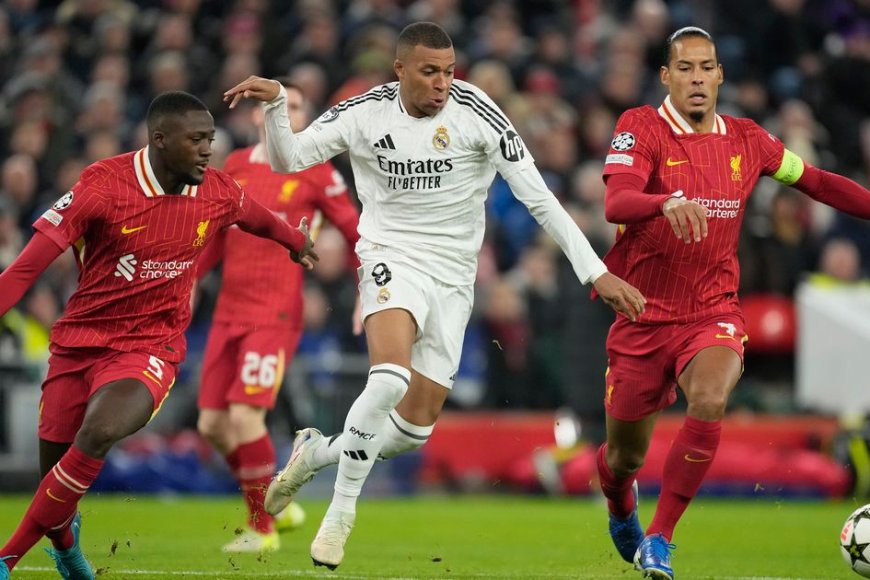
The duel between Mbappé and Van Dijk will attract headlines, but the midfield battle may decide the tempo. Federico Valverde’s vertical energy against Alexis Mac Allister’s positional awareness offers a contrast of rhythm. Slot is likely to deploy Dominik Szoboszlai higher to link with Cody Gakpo and Hugo Ekitike a trio that combines movement with unpredictability but often struggles for finishing efficiency.

Anfield remains Liverpool’s intangible advantage. Under Slot, they’ve lost just once at home in Europe, and the noise under the lights still carries a psychological weight few venues can match.

Yet Madrid is uniquely immune to intimidation. Their experience in hostile stadiums from Istanbul to Manchester gives them a calmness that neutralizes emotion. Alonso, of all people, knows that better than anyone.

The metrics paint a close contest. According to Opta projections, Madrid have a 44% chance of winning, Liverpool 33%, with a 23% draw probability. Expected goals models predict a tight affair, 1.6–1.4 in Madrid’s favor. But numbers don’t account for moments of chaos and it’s in chaos that Liverpool have historically found their spark.

Whatever the outcome, this fixture feels less like a grudge match and more like a generational passing of the torch. Alonso’s Madrid play with the structure Liverpool once perfected; Slot’s side, meanwhile, are learning how to rediscover it. For all the tactical nuance and statistical analysis, one truth endures when these two meet under European lights, something unforgettable usually follows.


ABAYO Bonheur ABAYO Bonheur is a professional sports journalist with extensive experience across multiple radio stations and digital platforms. He holds a degree in Journalism and Communication from the University of Rwanda, where he honed his skills in reporting, storytelling mainly documentaries. Throughout his career, Bonheur has gained both tangible experiences in live broadcasting and reporting, as well as the ability to maintain anonymity when covering sensitive stories. His versatility allows him to produce insightful, accurate, and engaging content across a variety of sports, earning him recognition for professionalism and reliability in the field.

Liverpool vs Real Madrid: Two Giants Meeting Again, but in Different Worlds

Nov 4, 2025 - 20:02
 0
Liverpool vs Real Madrid: Two Giants Meeting Again, but in Different Worlds

From Kyiv in 2018 to Paris in 2022, Liverpool and Real Madrid have defined Champions League storylines across a decade. Now, in November 2025, they arrive at Anfield facing drastically different realities: Liverpool searching for structure under Arne Slot, and Real Madrid riding the momentum of Xabi Alonso’s tactical precision.


Alonso’s return to Anfield carries a narrative weight that statistics can’t quantify. The Basque coach once Liverpool’s midfield metronome now commands Europe’s most efficient side.

Madrid has won 12 of their first 13 games across all competitions, boasting an average possession of 61% and conceding only nine goals. Yet beneath that impressive record lies a growing question: how sustainable is their reliance on individual brilliance from Kylian Mbappé and Jude Bellingham?

Liverpool’s own story is one of rebuilding identity. Slot inherited a squad still adjusting to life after Jürgen Klopp’s gegenpressing empire.

The Dutchman’s football is more patient, more positional but also, at times, more uncertain.In their last five domestic games, Liverpool have averaged 63% possession but produced just 1.1 expected goals (xG) per match, a number that betrays their creative stagnation.

Much of the tactical intrigue tonight revolves around Trent Alexander-Arnold. Once Liverpool’s creative heartbeat, he now returns to Anfield wearing white, not red. Alonso has repurposed him as an “inverted right-back” a role that suits his passing range but demands defensive discipline. The home crowd’s reception will be emotional; his presence symbolic of the broader exchange between Liverpool’s past and Madrid’s future.

Slot’s biggest concern is control. Liverpool has conceded first in seven of their last ten matches a trend that reflects not only defensive frailty but psychological fragility. The partnership between Virgil van Dijk and Ibrahima Konaté remains solid individually, but gaps emerge when full-backs push high and midfield coverage falters. Opponents have exploited those transitional spaces ruthlessly.

Madrid, meanwhile, have mastered game management under Alonso. They press selectively, preferring to compress the middle third and counter at terrifying speed. In the Champions League so far, they’ve scored six of their eight goals in under ten seconds of regaining possession. That data underlines a philosophical shift: Madrid’s domination is less about sustained control, more about surgical precision.

The duel between Mbappé and Van Dijk will attract headlines, but the midfield battle may decide the tempo. Federico Valverde’s vertical energy against Alexis Mac Allister’s positional awareness offers a contrast of rhythm. Slot is likely to deploy Dominik Szoboszlai higher to link with Cody Gakpo and Hugo Ekitike a trio that combines movement with unpredictability but often struggles for finishing efficiency.

Anfield remains Liverpool’s intangible advantage. Under Slot, they’ve lost just once at home in Europe, and the noise under the lights still carries a psychological weight few venues can match.

Yet Madrid is uniquely immune to intimidation. Their experience in hostile stadiums from Istanbul to Manchester gives them a calmness that neutralizes emotion. Alonso, of all people, knows that better than anyone.

The metrics paint a close contest. According to Opta projections, Madrid have a 44% chance of winning, Liverpool 33%, with a 23% draw probability. Expected goals models predict a tight affair, 1.6–1.4 in Madrid’s favor. But numbers don’t account for moments of chaos and it’s in chaos that Liverpool have historically found their spark.

Whatever the outcome, this fixture feels less like a grudge match and more like a generational passing of the torch. Alonso’s Madrid play with the structure Liverpool once perfected; Slot’s side, meanwhile, are learning how to rediscover it. For all the tactical nuance and statistical analysis, one truth endures when these two meet under European lights, something unforgettable usually follows.